
Essentials of Mass Spectroscopy

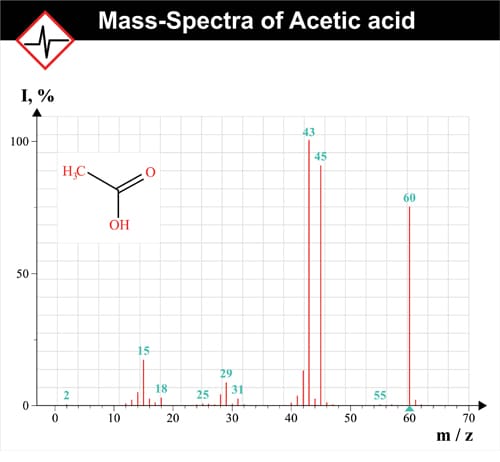
Mass spectroscopy is distinctly different from other spectroscopic techniques. It has found large number of applications in several areas of basic research and product development covering pharmaceuticals, foods, environmental pollution monitoring, doping investigation in sports, pesticide residue analysis, biochemistry, clinical investigations and petroleum products analysis. The increasing popularity of mass spectroscopy results from its ability to provide vital information on :
- 摩尔和Isotopic masses
- Molecular structure and formula confirmation
- Positive identification of compounds present in complex mixtures
The present article is an attempt to provide a basic introduction to this versatile technique.
质谱仪原理
The main objective of the mass spectrometer is to identify and quantify the components of a mixture. The molecule in its vapour state is bombarded with high energy electrons (generally around 70 ev). The energy of the electrons knocks an electron from the molecule resulting in a charged molecule which undergoes fragmentation to yield smaller molecules. The molecular ion and resulting fragments are separated according to their mass to charge ratios (m/z) using electrostatic fields or a combination of magnetic and electrostatic fields. The detector generates electrical signals depending on the number of specific m/z ratio ions striking it. The mass spectrum is recorded as vertical lines representing concentration of molecular fragments corresponding to the individual m/z values. The most intense peak of the spectrum is referred to as the base peak and peaks arising at m/z values greater than the base peak are referred to as isotopic peaks which arise due to the natural abundance of different isotopes of different elements present in the parent molecule.
A mass spectrometer essentially comprises of following components:
- 样品进口设备
- Ion source and ionization chamber
- 质量分析仪
- Detector
- 输出设备
这些设备的细节可以在标准论文中找到。然而,随后的物品将覆盖常用的电离过程和不同的质量分析仪。
重要的是要认识到,即使是经验丰富的质谱,也不能从多个可能的结构到达明确的结构。结构构象需要与疑似化合物的质谱比较。现代光谱仪器确实通过频谱搜索库提供了易于包含数百种复合类别的质谱数据基础的谱图图书馆。光谱覆盖物有助于缩小疑似化合物。可以从其他物理化学研究和来自其他光谱技术的光谱数据到达进一步的确认。
Hyphenated techniques such as GC-MS, LC-MS are useful and extend the sensitivity of detection and selectivity by prior separation of complex mixture components before entering the mass spectrometer. Some of these techniques will be covered in subsequent articles.


Responses